Research
Intellectual Adventures
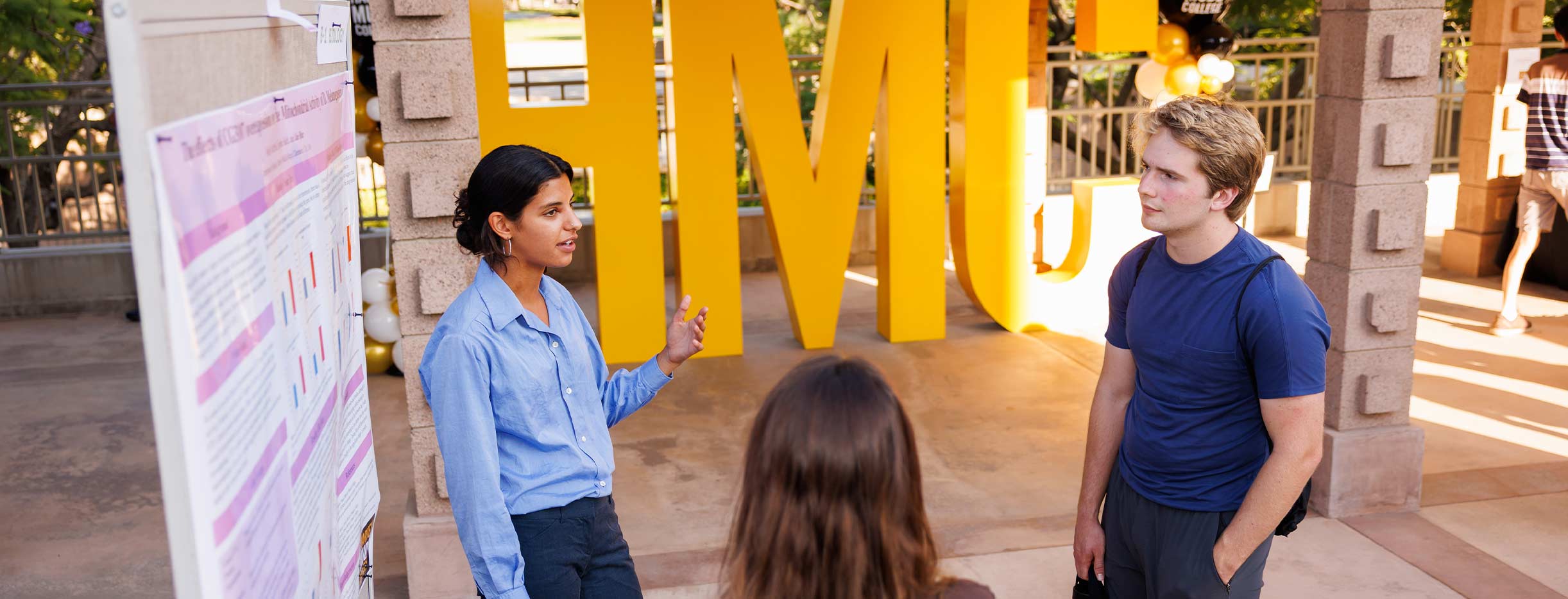
This year’s Poster Research and Scholarship Celebration, held in conjunction with the College’s 70th Anniversary Symposium, brought the campus community together for an outdoor showcase of student research. Nearly 200 students collaborated with faculty mentors across all HMC departments and off-campus, exploring new ideas and discoveries throughout the summer. Attendees circulated among the posters, engaging presenters in lively conversation and offering encouragement. Here’s a selection of summer research projects.
Computer Science
CuteSnaps
Student: Amy Li ’28
Advisor: Zachary Dodds, Leonhard-Johnson-Rae Chair of Computer Science
CuteSnaps is a web-based photobooth application that makes capturing and sharing memories fun and collaborative. Users can take photostrips, decorate them with themed stickers and overlays and co-edit photos with friends in real time. CuteSnaps runs entirely in a browser, making it usable across devices and ideal for social settings like student clubs, events or parties. It has attracted over 120 beta users, showing strong engagement and viral potential.

Engineering
Systems Engineering for UAV Swarm Wildfire Detection and Monitoring
Student: Drake Gonzales ’27
Advisor: Adyasha Mohanty, assistant professor of engineering
Current wildfire monitoring technologies rely heavily on resource-intensive systems, including satellite thermal imagery, ground-based thermal sensors and observation towers, which often fall short for timely detection and are frequently used only after a fire has occurred. Gonzales sought to develop a cost-effective, scalable solution that can evolve into a swarm of autonomous UAVs. He built a DIY quadcopter drone, equipped with a Jetson Orin Nano, to enable real-time AI-driven fire detection and monitoring and tested it over the Harvey Mudd campus.

Chemistry, Engineering, Physics
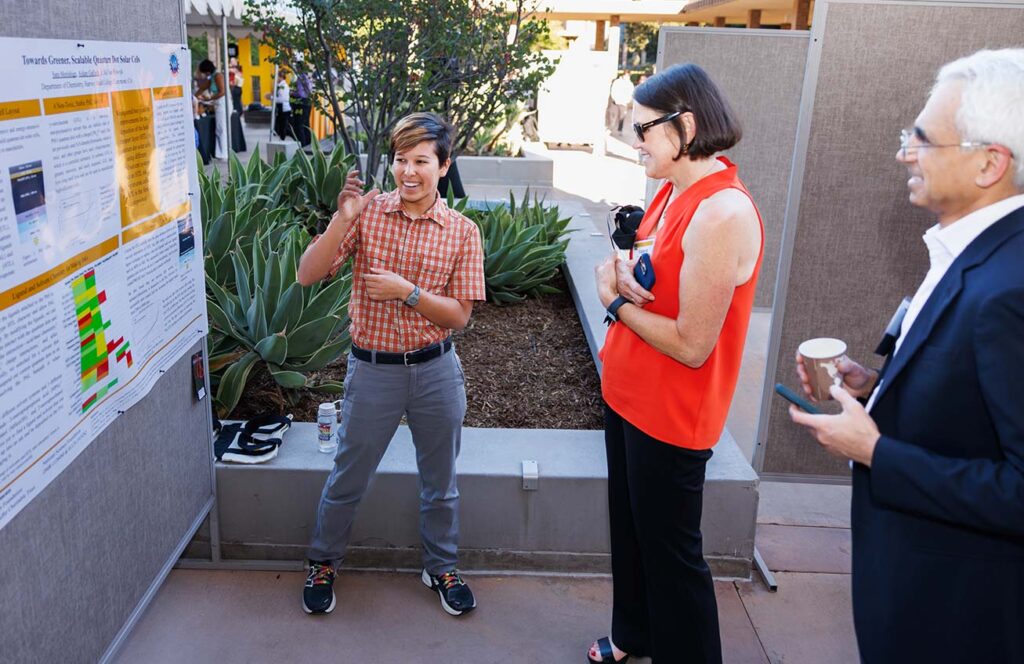
Towards Greener, Scalable Quantum Dot Solar Cells
Students: Sara Morishige ’27 (pictured below), Aidan Gallade ’27
Advisor: Hal Van Ryswyk, John Stauffer Chair of Chemistry
Quantum dot solar cells (QDSCs) use far less material and energy to manufacture compared to traditional silicon solar cells. Currently, the standard deposition of the hole transport layer (HTL) is an inefficient, non-scalable, multi-step process that damages the photoactive layer beneath it. Researchers explored two possible improvements for the deposition of the HTL, using 25 solvents and three ligands, and found one pair that formed an ink resulting in a successful inverse cell. They found that γ-valerolactone is an effective solvent for the photoactive layer; it is a greener, non-toxic, non-psychoactive alternative to common solvents. The search continues for a solvent system for an HTL ink that can be deposited on top of the photoactive layer without damaging it.
Computer Science
Action Recognition Robustness
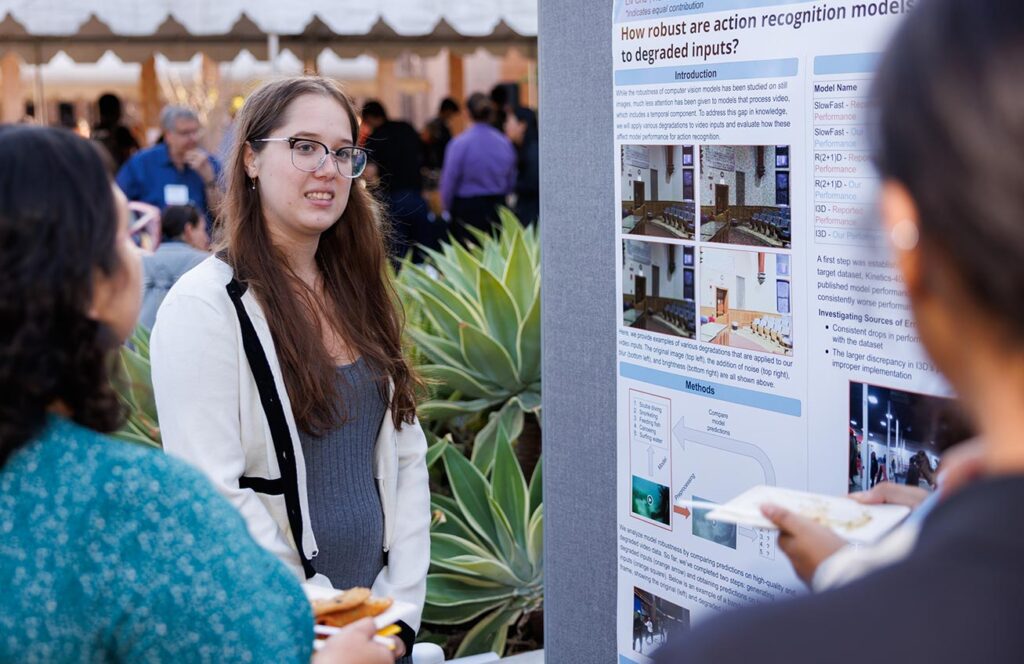
Students: Liv Chu ’27, Healani Dowd ’27 (pictured below), Nicolas Riley CMC ’27
Advisor: Calden Wloka, assistant professor of computer science
While the robustness of computer vision models has been studied on still images, much less attention has been given to models that process video, which includes a temporal component. To address this gap in knowledge, researchers applied various degradations to video inputs and evaluated how these affect model performance for action recognition.
Biology
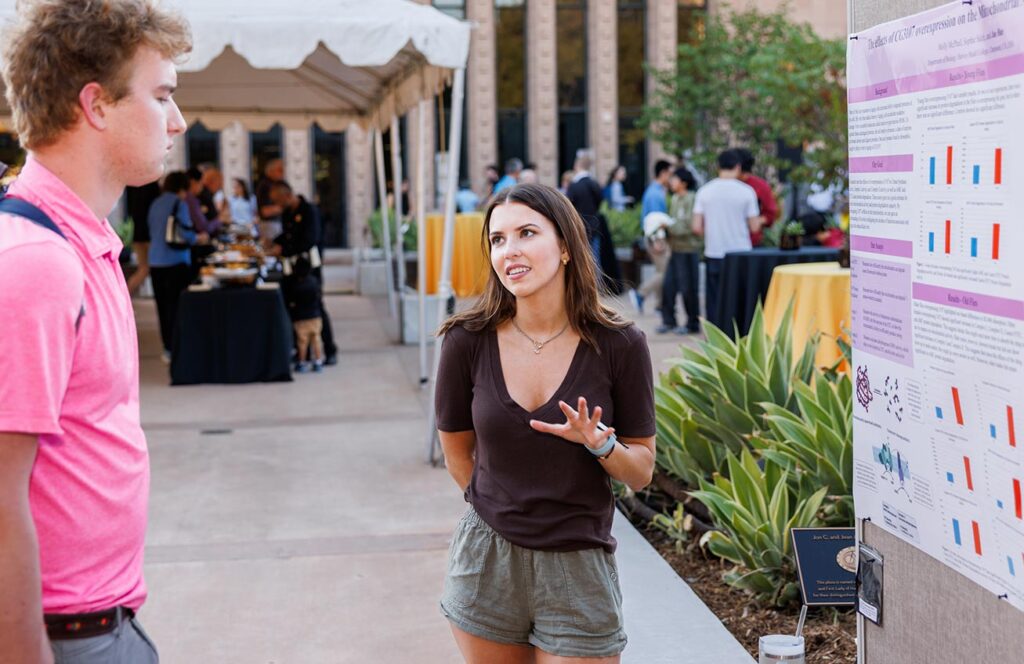
The Effects of CG3107 Overexpression on the Mitochondrial Activity of D. Melanogaster
Students: Sophie Saleh ’28, Molly McPhail ’28 (pictured below)
Advisor: Jae Hur, associate professor of biology
One of the key drivers of aging is the decreased ability to degrade damaged proteins. According to the free radical theory of aging, cells accumulate oxidative damage from unstable molecules called reactive oxygen species. To degrade these damaged proteins, the cell employs proteases, a class of enzyme that breaks down and digests proteins. CG3107 is one such protease found in Drosophila that is thought to play a role in aging. By investigating CG3107’s effects on the mitochondria, researchers gain an understanding of its role in mitigating the decline of function associated with aging at the intracellular level.
Chemistry, Hixon Center
Stranded in the Smellscape
Student: Tzaara Jauhar ’27
Advisor: Sarah Kavassalis, assistant professor of climate and chemistry
Sensation is the translation of physical stimuli into neural signals, and perception is the process by which we interpret these signals. In the case of smell, sensation is the translation of volatile organic compounds we can detect in the air to neural signals, and our perception of them includes the label we assign, such as “rose” or “pungent.” Building a perceptual space for olfaction is a complex task with significant barriers: Most smells we’re familiar with are actually a mixture of many different compounds, and our own vocabularies restrict our ability to describe odors. For decades, olfactory research studies have rarely built on each other. Jauhar aimed to synthesize olfactory literature across disciplines, with an emphasis on evaluating the data collected over the years.
