Alumni
Accessible Independence
Mudders create affordable AI technology to help those with vision impairments
The idea for an AI-powered wearable device for the blind and visually impaired resulted from being in the right place at the right time.
The right place was Harvey Mudd College, where Ket Hollingsworth ’25 (CS/math) arrived in 2021 with an interest in robotics and embedded systems. He got involved in the MuddSub Club and helped build underwater vehicles for international RoboSub competitions. He also met his suitemate Dominick Quaye ’25, an engineer who was building things, like a drone that delivers gas masks through windows during apartment fires, an attachable automatic braking system for cars and a makeshift plasma reactor.
The right time was 2023 when a multi-modal language learning model became available for the first time via an application program interface. Hollingsworth pitched an idea to Quaye: An app built for the blind, designed to provide qualitative descriptions that were never before possible.
Quaye asked, “Why would we build on top of a visual interface for those who struggle to see? Why not build a wearable with tactile buttons?”
The current cost for wearables is expensive—many thousands of dollars. “We knew we could do it for cheaper, and the market already existed. From then, the idea was born! I was inspired and excited to see what we could build,” says Hollingsworth.
Quaye and Hollingworth spent the next two months working on a prototype for a product that could potentially help some of the 340 million people worldwide who are blind or who have a moderate to severe vision impairment. “Rates of moderate to severe vision impairment are rising,” says Hollingsworth, “and vision loss often carries a real economic burden for the people it affects.”
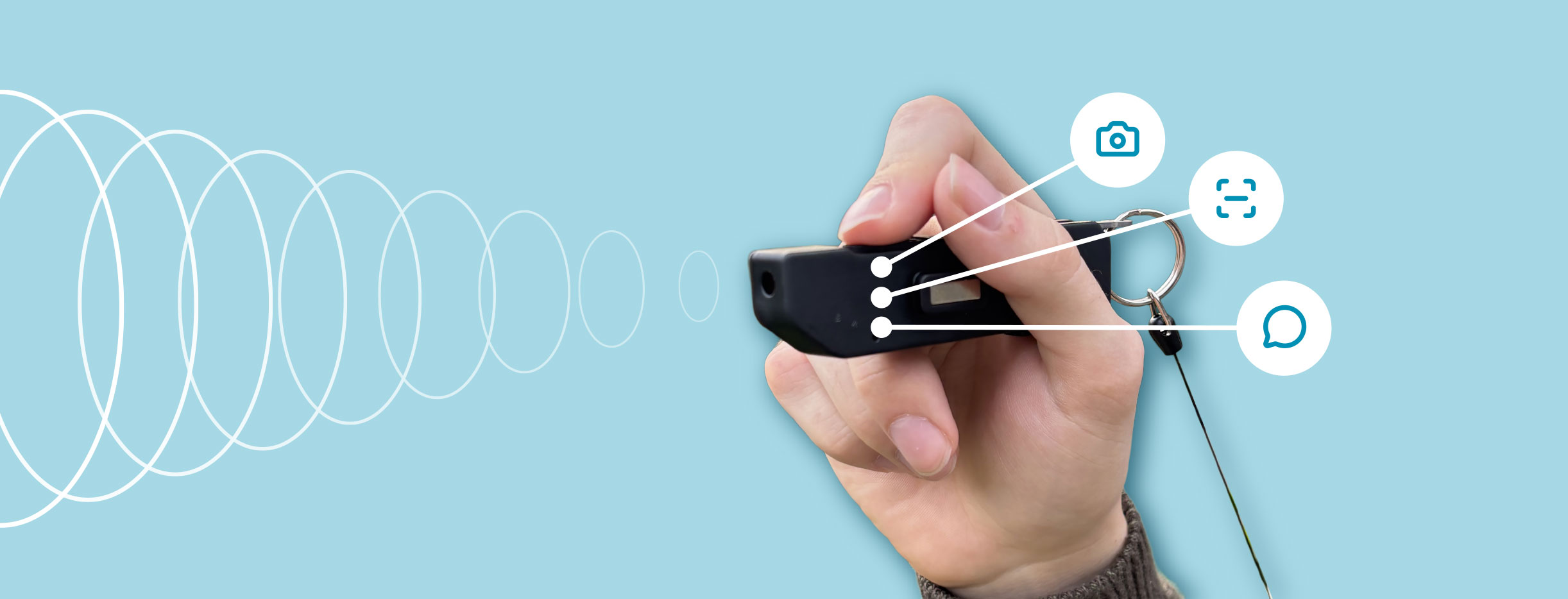
With one click, the ExploraVist wearable describes a user’s surroundings: reading the text off a menu, helping organize a pantry or simply capturing and sharing moments. It clips onto any standard pair of glasses and can be hung around the neck with a lanyard, attached to a belt or slipped into a pocket.
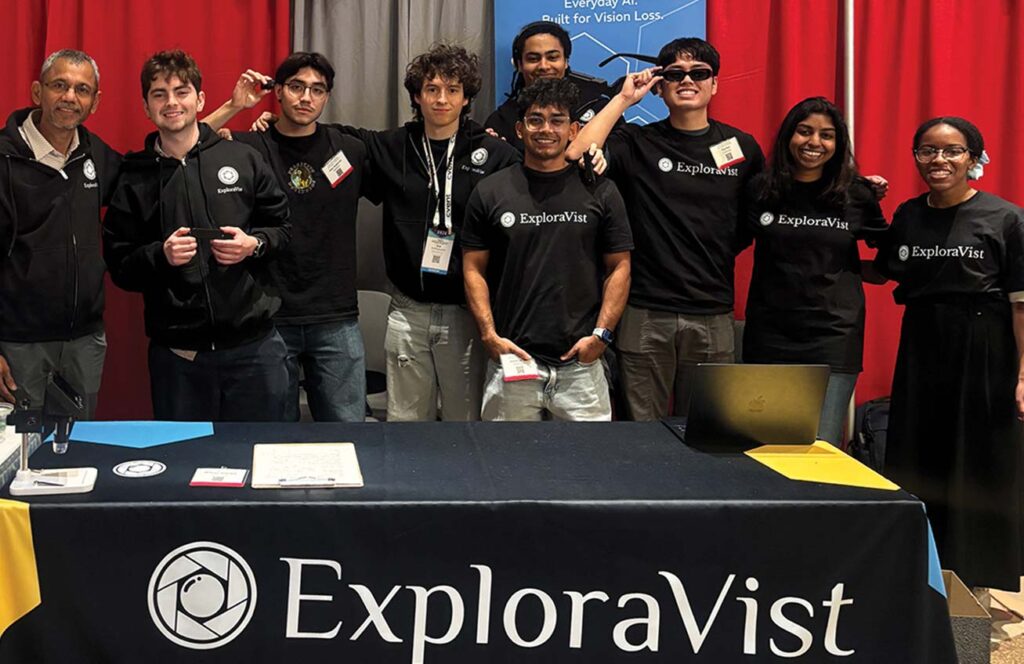
Armed with the mission of building affordable AI wearable technology for people who are blind and low vision, Quaye and Hollingsworth attended pitch competitions, including Pomona Ventures’ SageTank (placing second in 2024 and first in 2025) and the Claremont Accelerator’s Demo Day. They took the Entrepreneurship class at Mudd and were sponsored by The Rick and Susan Sontag Center for Collaborative Creativity (The Hive) to conduct the ExploraVist Clinic, which allowed them to perform extensive user testing to ensure that the product aligned with human-centered design principles. The Clinic, advised by engineering professor TJ Tsai and liaised by Asha Srikantiah, also led to their first investor. “All of these opportunities and resources combined provided me the confidence and motivation to continue moving forward with the project,” says Hollingsworth.
Early on, the ExploraVist team performed testing at Inland Empire Lighthouse for the Blind, a nonprofit that offers programs, classes and activities to enrich and train visually impaired people. Hollingsworth says that the testers loved the wearable. “Hearing people express how much this could help them, and hearing them talk about future use cases, it was motivating.”
The ExploraVist team—mostly Mudders—are navigating many entrepreneurial decisions, including funding, growth and technology platforms. This spring, ExploraVist was one of the exhibitors at the CSUN Assistive Technology Conference, which features assistive technological advances, products and services and is the largest of its kind in the world. “We were able to provide live demos of our app-plus-wearable combo, secured key contacts in the space and grew our waitlist from a few dozen to over 100,” Hollingsworth says. They plan to start shipping the wearable in mid-September.
“What keeps me committed to ExploraVist is the impact behind it,” says Hollingsworth. “We want to put genuinely capable technology in the hands of people worldwide living with moderate-to-severe visual impairment, at a price that makes independence accessible.”