Research
Capstone Roundup
From the depths of the ocean to the vastness of the solar system, Harvey Mudd students are pushing the boundaries of what is known. Students shared their senior thesis research and course capstone projects during Presentation Days. This selection of projects demonstrates some of the research achievements.
Visit Presentation Days 2026 Abstracts for more research descriptions.
Biology
Demography and Dispersal of Joshua Trees
Student: Callie Dawson ’26
Advisors: Stephen Adolph, Stuart Mudd Professor of Biology
Relatively little is known about Joshua tree dispersal, creating a knowledge gap that could compromise conservation success amid climate change. Dawson’s study aims to shed light on potential dispersal patterns at the trees’ range edges. The research addressed several questions: Are Joshua trees dispersing in a particular direction (elevationally and/or latitudinally)? Do these trends follow general predictions? What is the dispersal rate, and does the cardinal direction of dispersal differ on slopes versus flat surfaces? What is the demography of Joshua trees at range edges?

Chemistry
Designing a Stereotunable and Chemically Degradable Polymer
Student: Tatiana Cardoso ’26
Advisor: Spencer Brucks, assistant professor of chemistry
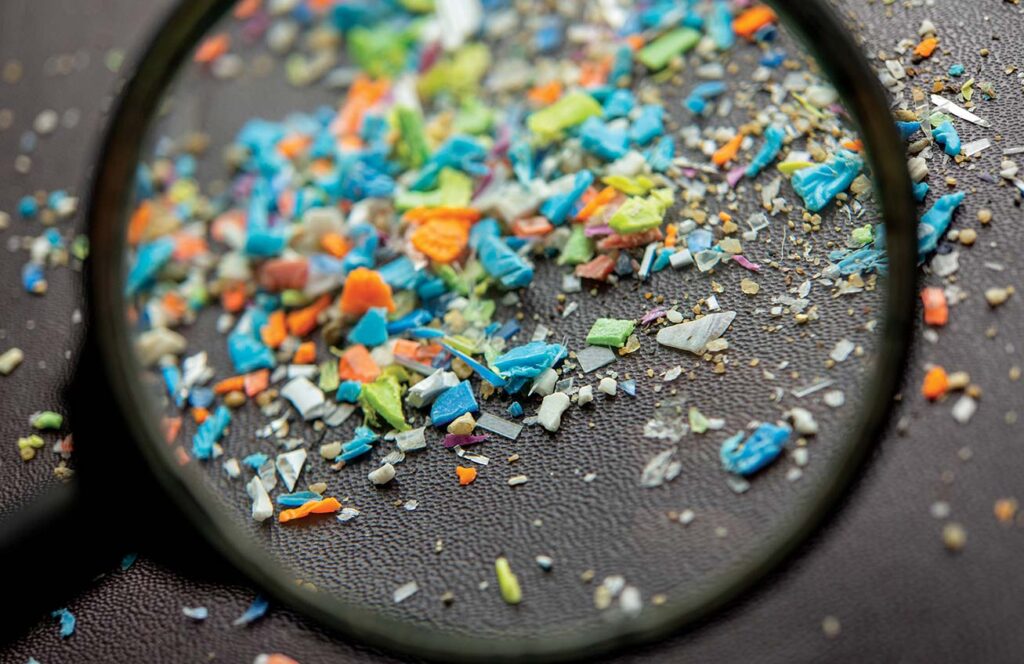
Plastic production doubled between 2000 and 2019, leading to significant microplastic accumulation. To address this, scientists are developing degradable plastics by manipulating polymer backbone stereochemistry. While previous research on polydihydrofuran showed limited stereochemical control, this thesis proposes using a high ring-strain oxetane monomer for ring-opening metathesis polymerization (ROMP). This approach aims to create sterically tunable and chemically degradable polymers. Cardoso optimized the photochemical synthesis of the oxetane monomer and investigated various ROMP reaction conditions, including time, temperature and concentration, to evaluate its polymerization viability.
Chemistry
Investigating Temperature Dependence of Oxygenated Organic Aerosol in Eastern L.A. County
Student: Greyson Karis-Sconyers ’26
Advisor: Lelia Hawkins, professor of chemistry; Hixon Professor of Climate Studies; director, Hixon Center for Climate and the Environment
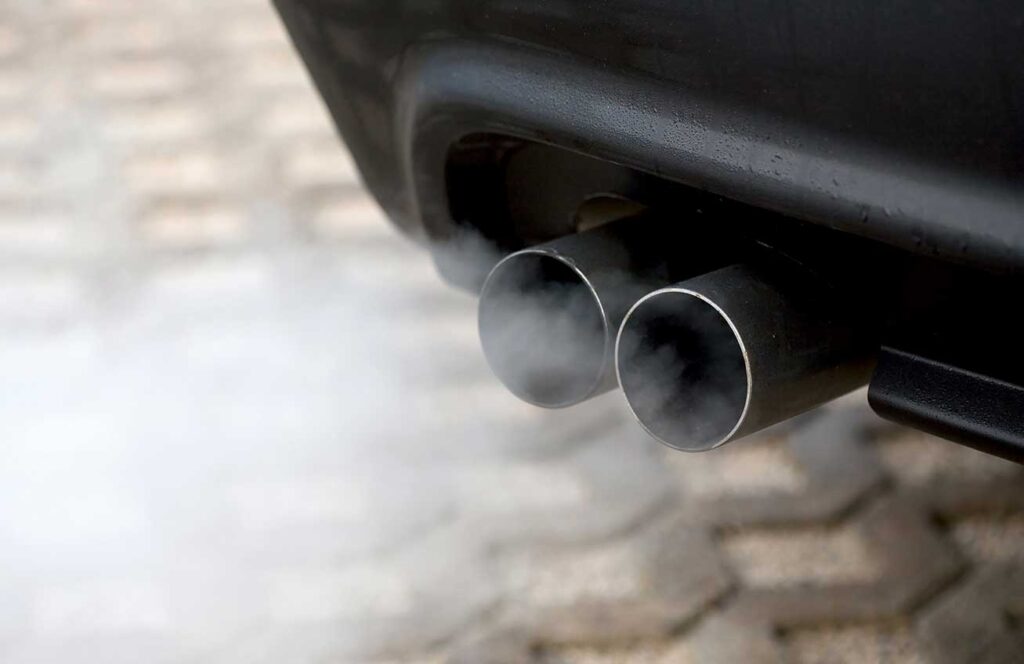
Global air pollution, specifically PM2.5, poses severe health risks to humans, including respiratory mortality and elevated blood pressure. Climate change exacerbates these effects by intensifying heat waves. Organic aerosols, a major component of PM2.5, are highly temperature-sensitive. To analyze temperature’s role in Los Angeles pollution, Karis-Sconyers used mass spectrometry to measure aerosol size and composition. Through source apportionment and factor analysis, researchers distinguished primary and secondary organic aerosols. By correlating 2021 and 2025 data with local meteorology, they determined how temperature influences the formation of this critical pollutant.
Mathemtics
Toward Conditions for Consensus of Noisy Bounded-Confidence Models
Student: Madeline Reeve ’26
Advisors: Heather Brooks, assistant professor of mathematics; Christopher Miles, University of Utah Department of Mathematics
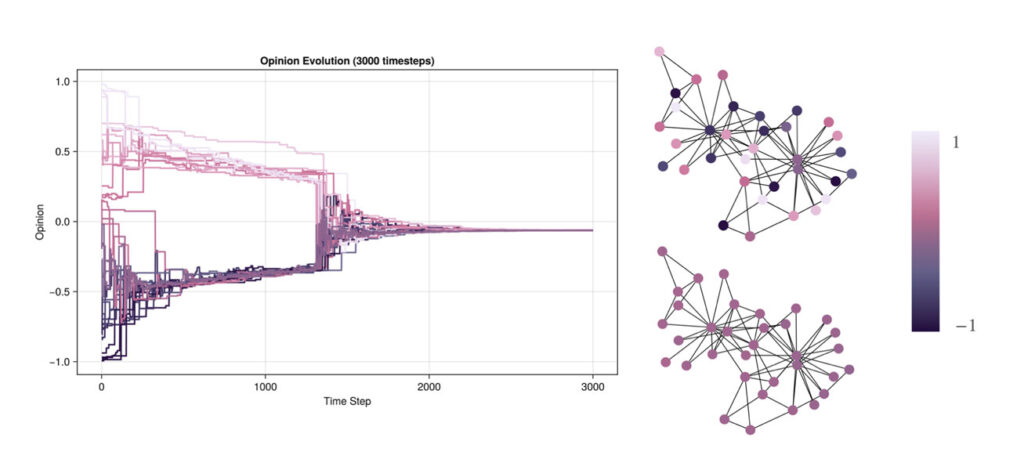
Models of opinion dynamics aim to describe the spread of opinions over time in a social network. However, many canonical models are deterministic and thus may fail to capture uncertainty present in social interactions. This work investigates the effect of adding noise into bounded-confidence models, a class of opinion dynamics models where agents are more likely to be influenced by opinions close to their own. In particular, we propose a noisy modification of the Deffuant–Weisbuch model. We prove that in this model all agents eventually adopt the same opinion: This model converges to consensus.
Physics
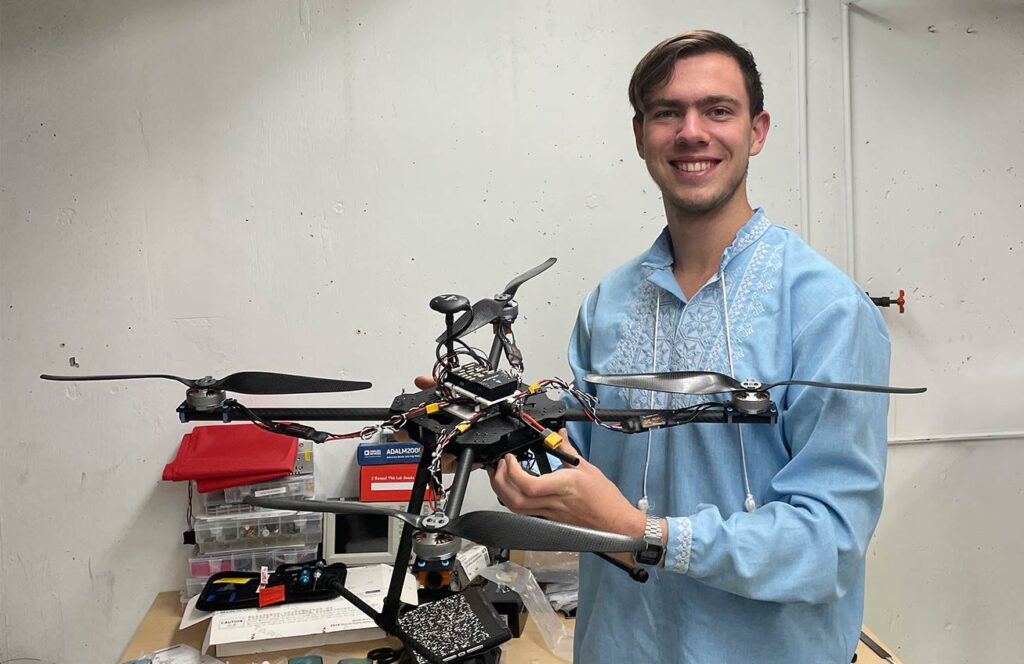
Real-Time Autonomous Drone Navigation in GNSS-Denied Environments
Student: Ivan Dudiak ’26
Advisor: Jason Gallicchio, associate professor of physics
Real-time navigation is essential for autonomous drone operations in GPS-denied environments. While algorithmic progress is steady, matching GPS reliability in real time remains a challenge. This study evaluates mapping techniques, selecting a robust visual-inertial odometry system for local positioning paired with satellite image matching for global updates. After validating the system on open-source datasets, Dudiak developed an algorithm to enhance stability against environmental interference. He successfully deployed and tested the system on onboard hardware, demonstrating real-time performance and identifying future pathways for increased resilience.
Shanahan Project
Harvey Mudd Racing (Formula SAE)
Student presenters: Max Conine ’28, Audrey Gruian ’26, Hugo Guckert ’27, Kathy Guo ’28
Advisor: Josh Brake, associate professor of engineering
Harvey Mudd Racing (HMR) is HMC’s rookie Formula Society of Automotive Engineers (SAE) team, dedicated to designing, building, testing and racing a prototype Formula-style race car as part of SAE’s international collegiate-level competition. HMR seeks to foster innovation, leadership and technical excellence, as well as provide students with an opportunity to hone real-world skills while contributing to a fast-paced and multidisciplinary project. In 2025–2026, HMR worked to design and begin manufacturing its first competition car in preparation to compete in spring 2027.