Faculty
Dangerous Questions
During fall, a panel of faculty from the Department of Humanities, Social Sciences, and the Arts explored “dangerous questions” from a variety of disciplines to understand and respond to challenges facing American universities.
Topics addressed were “What Would Shakespeare Say?” (Ambereen Dadabhoy, associate professor of literature), “What Can Art Do During a Fascist Takeover?” (Rachel Mayeri, artist and professor of media studies), “Creative Politics as a Strategic Response to Authoritarianism” (Paul Steinberg, Malcolm Lewis Professor in Sustainability and Society; professor of political science and environmental policy), “Invasive Species: Blaming Dysregulated Plant Neighbors Is a ‘Settler Move’ to Innocence” (Anup Gampa, associate professor of psychology) and “Geography Against Immediacy” (David K. Seitz, associate professor of cultural geography).
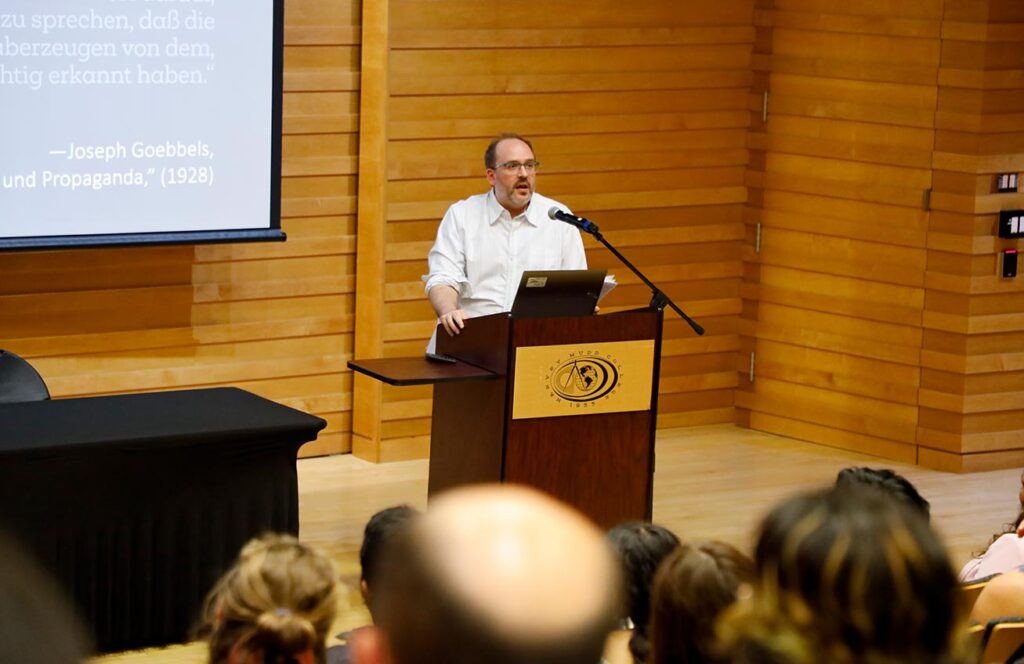
During his talk, “Sounding (Anti-) Authoritarian: A Few Vignettes,” David Wilson, assistant professor of music, examined how music reflects and resists power across time and place. Through three case studies—Nazi Germany, Maoist China and post-Fukushima Japan—the talk reveals music’s relationship to politics and propaganda.
In 1934, composer Paul Hindemith attempted to appease the Nazi regime with David Wilson, assistant professor of music a patriotic symphony only to be blacklisted after audiences used the performance to protest. Wilson concluded, “Appeasement does not protect.”
When Mao Zedong launched the Cultural Revolution in 1966, he sought to “protect his position at the apex of Chinese politics. To the greater Chinese public, however, the Cultural Revolution was branded as, ‘a movement to touch people to their very souls,’” said Wilson. At its heart was a new form of cultural production called “the model works”: lavish operas and ballets merging politics and art that became instruments of persuasion and control. “Music can distract from the intrinsic incoherence of political movements,” Wilson observed.
After Japan’s Fukushima Daiichi Nuclear Power disaster in 2011, indie and amateur musicians filled the silence left by major artists tied to corporate power, galvanizing the nation’s largest protest movement in 50 years. Wilson noted, “Music is a powerful tool in any political debate, and all parties will vie to control it.”
Wilson argued that music is never politically neutral; it “evades the logical” and moves people emotionally, which is precisely why regimes seek to control it. From the Washington Mall to Tiananmen Square, Wilson said, revolutionary moments have been anchored by and sounded through music. “Sound—even wordless, non-semantic but synchronized sound—is power,” a reminder that music’s emotional resonance can both sustain authority and inspire defiance.

and Paul Steinberg