
Top Story
How to Build a Community of Learners
Chemist, entrepreneur and educator Bernie Santarsiero ’75 has spent his career cultivating talented researchers.
Written by Queen Muse Chemist, entrepreneur and educator Bernie Santarsiero ’75 has spent his career cultivating talented researchers.
Written by Queen Muse
Growing up as an only child in a middle-class family in Claremont, California, Bernie Santarsiero ’75 felt fortunate. At an early age, he discovered his passion for science and math, and his parents provided him with all the resources he needed to explore his interests, from science kits to advanced calculators. During high school, Santarsiero spent his free time tutoring disabled students in elementary school, recording chemistry textbooks for blind students and, for one summer, tutoring Black and Latino students in advanced science and math through “Project Open Future,” a program designed for high-achieving inner-city students in Los Angeles. It was during these experiences that Santarsiero came to understand that not everyone had access to the same resources. “It gave me a firsthand view of the differences in access,” Santarsiero says. “The students in Project Open Future were brilliant kids, but because they came from very low-income communities and families, they didn’t have the same advantages I had. That made a real impact on me.”
As director of Underrepresented Minority (URM) Research Initiatives at the University of Illinois Chicago (UIC) for 25 years, Santarsiero created pathways for underrepresented students to excel in STEM and biomedical research—a journey that began at Harvey Mudd College.
While a student at Harvey Mudd, Santarsiero connected with professors and mentors who laid a strong foundation for his dual commitment to research and education. “Harvey Mudd instilled in me a passion for rigorous inquiry,” Santarsiero says. “The professors treated every student like a potential scientist, instilling both the technical skills and the mindset needed to question, seek and understand.” That emphasis on nurturing scientific thinking in all students would later influence his approach to cultivating underrepresented minority researchers who may not initially see themselves in scientific careers.
After earning his bachelor’s degree in chemistry, Santarsiero continued his studies in graduate school. Driven by a curiosity about how scientific discovery can translate into real-world solutions, he later co-founded Syrrx, a drug discovery company that focused on advancing diabetes treatments and pioneering techniques in protein expression and structural biology. His work contributed to the development of two FDA-approved diabetes medications: alogliptin and pioglitazone.
Santarsiero’s career is defined not only by his scientific achievements but also by his dedication to ensuring equal access to educational opportunities. “At UIC, I had the support of colleagues to engage in stellar research and develop URM training programs.”
Santarsiero worked to advance research and support young UIC scientists from diverse backgrounds. His leadership in URM Research Initiatives provided underrepresented students with targeted research opportunities, internships and workshops that fostered essential skills while building a sense of community among minority students. As a first-generation college student who is both Latinx and gay, his approach to DEI is holistic. He sees diversity as essential not only to creating equitable opportunities but also to fueling innovation.
“When we make science accessible and inclusive, we not only help individuals but enrich the entire scientific community,” he says. “A broader range of perspectives in research unlocks new ways of thinking that ultimately lead to better science.”
“When we make science accessible and inclusive, we not only help individuals but enrich the entire scientific community. A broader range of perspectives in research unlocks new ways of thinking that ultimately lead to better science.”
BERNIE SANTARSIERO ’75
Over the past decade, he’s pioneered a variety of programs aimed at fostering an inclusive academic community, including the DuSable Scholars Program, which supports underrepresented Black students in STEM fields; the Bridge to Faculty (B2F) initiative, designed to attract scholars to UIC and diversify the faculty; the Portal to Biomedical Research Careers Postbaccalaureate Research Education Program, which helps STEM students enhance their research skills and laboratory experience in preparation for graduate studies; and the L@s GANAS program, which seeks to increase the number of Latinx professionals in STEM. Latin@s Gaining Access to Networks for Advancement in Science (L@s GANAS ), one of Santarsiero’s most impactful initiatives, provides financial assistance to Latinx students, promotes their retention in STEM majors and cultivates a community where Latinx students can view their cultural heritage as an asset in the lab. For example, Santarsiero lectured in a UIC Honors course on ethnobotany and drug discovery and how natural products are uniquely tied to culture, history and science.
“The URM Research Initiatives are not just about providing access,” he says. “It’s about building a community of learners who challenge each other, learn from each other and push each other to excel.”
Under his direction, these initiatives have created opportunities for hundreds of students to participate in research that they may not otherwise have considered. His work has not gone unnoticed.
In May 2025, he received the Lifetime Service Award from the Chancellor’s Committee on the Status of Latinos. In July, at the annual national conference, he was elected as a Fellow of the American Crystallographic Association, and in November, he received the UIC Chancellor’s Academic Professional Excellence Award for “exceptional commitment to education equity and outstanding leadership across research and academic initiatives.” In 2026, he is slated to receive another award: the UIC Faculty Diversity, Equity and Inclusion Award, further recognizing his longstanding impact on science and education.
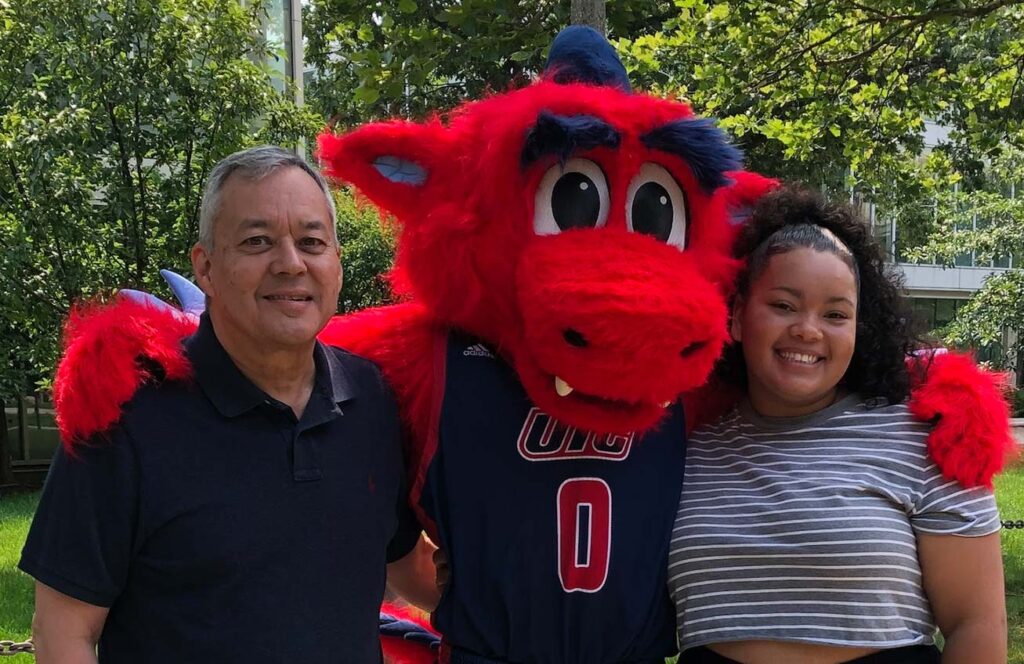
In 2024, Santarsiero was highlighted by the American Society for Biochemistry and Molecular Biology for being a gay role model involved in DEI. He was invited to the National Institutes of Health to give a talk about training programs at UIC that foster equity and diversity in science and to the U.S. Department of Education headquarters to speak about the critical use of data in promoting student success. He received the 2024 Diamond Award from the Not Alone Foundation for his over a decade of diversity work at UIC. His initiatives also ear ned UIC the NIH Institutional Excellence in DEIA Prize for Biomedical and Behavioral Research, celebrating L@s GANAS and other programs he helped establish to bridge gaps in diversity, equity, inclusion and accessibility. His award-winning proposal highlighted UIC’s evolution over the past 15 years in developing a comprehensive DEIA strategy.
Although he retired from UIC in December 2025, Santarsiero remains committed to pushing the boundaries of his field and says he’s proud of his students who’ve already begun making their own contributions to science.
“Seeing students who once doubted their place in science now leading projects, publishing papers and applying to graduate programs—those moments are why I do this work,” he says.