Alumni
The Dynamic Sky
Astronomer Meredith Rawls ’08 is working to explore and protect the universe.
Meredith rawls ’08 found her way to astrophysics through a process of elimination—by ruling out chemistry, math, computer science, biology and engineering. Ironically, she says, she nearly failed her freshman physics course at Mudd. Nonetheless, she persisted, knowing she wanted a career in astronomy.
Rawls is a research scientist at the University of Washington who has, since 2016, been working on the Vera C. Rubin Observatory. This new facility, located on a Chilean mountaintop and equipped with the largest digital camera ever built, went live in June 2025. Rubin will repeatedly scan the sky for 10 years and create an ultra-wide, ultra-high-definition time-lapse record of our universe.
The Rubin Observatory aims to better understand dark matter, the solar system and the Milky Way, as well as explore “objects that change position or brightness over time.” Rawls’s work relates to the last goal, which she poetically calls the “dynamic sky.” The uniqueness of the Rubin Observatory, she explains, is that it will “survey the entire southern sky and build up a database of observations that are then available to the astronomical community to enable all kinds of amazing science.”
In June, the Rubin Observatory became fully operational, and released “first look” images on its website, which also includes videos and interactive tools like a Skyviewer and Orbitviewer. Along with the images, observatory staff released a data preview. Rawls says, “People have been using the data to do all kinds of early science, like finding new supernovae and testing out their own scientific workflows separate from what we produce.” The first official data release—which will contain packages of data Rawls and her colleagues prepare for scientists—won’t happen until 2026.
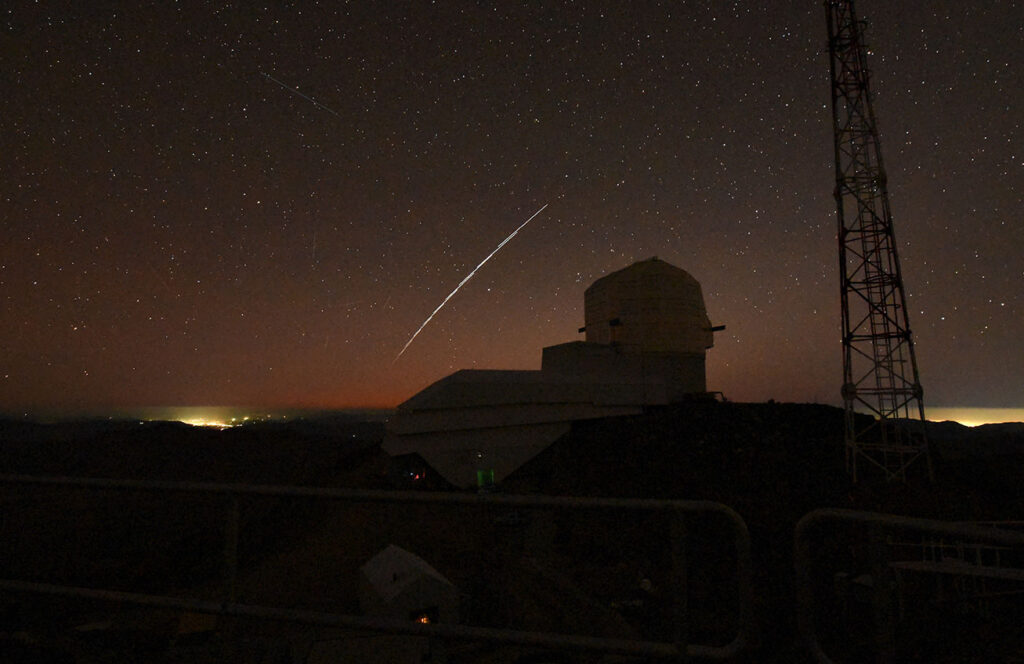
pollution in the distance. Photo credit: Alysha Shugart
Soon, people worldwide will see the observatory’s “alert streams,” which detail minute changes in the night sky. Astronomers will thus be alerted to a change between images almost immediately. Rawls works to ensure the algorithms detecting these changes are robust, “verifying and validating that the data products all of the different Rubin pipelines make are doing what we expect.” Rawls predicts there will be around 10 million of these alerts (similar to social media posts) every night. While alerts won’t include as much detailed information as full data releases because they are processed in real time, they will alert astronomers that the sky is changing in a certain area so follow-up observations can be made.
Although Rawls’s work with the Rubin Observatory is central to her role as a research scientist, she also works on other projects, including the impact of satellite constellations. “There are an increasingly large number of bright satellites being launched into low-Earth orbit—things like SpaceX Starlink,” she says. These satellites threaten to interfere with the work done by the Rubin Observatory because the telescope is so sensitive. “I use the analogy like bugs on a windshield to explain this. You’re trying to take a picture of some of these faint distant galaxies, and there’s this bright reflective satellite that just comes across and leaves a streak in your image.”
Rawls spends a lot of time developing tools and techniques to mitigate this interference, including liaising with companies and other stakeholders who are concerned about this problem. Beyond the effects on astronomers, satellites change the night sky. If we continue to let large numbers of satellites just get launched into orbit with no regulation or limits, Rawls says, it will be harder for people to view the stars. “You’re going to see more swarm-y moving things than you’ll be able to see stars in the Milky Way,” she says, noting that some of these objects appear even brighter than stars. This is a subject Rawls and several colleagues addressed in their 2022 Nature Astronomy article “The case for space environmentalism,” which views the impact of ever-increasing satellite constellations as akin to the pollution of the atmosphere and ocean. “It’s just a fundamental change that no one really consented to,” Rawls says, and this has unknown consequences. When these satellites burn up in the atmosphere, they can leave debris behind, she adds. The companies that make them seem to be assuming, she says, “that the atmosphere can take an infinite amount of surprise metals burning up in it without any repercussions.”
“If we continue to let large numbers of satellites just get launched into orbit with no regulation or limits, it will be harder for people to view the stars.”
MEREDITH RAWLS ’08
This is a difficult problem to address because it’s global in scope, Rawls says: “No one country can solve this independently.” While she believes satellites can be used constructively, she notes that the lack of regulation, and the slowness of regulatory bodies in acting to mitigate their impact is a problem for both astronomers and the larger global community.
This past August, Rawls participated in a gathering of experts to discuss the effects of satellite constellations, both on the Rubin Observatory and the wider sky and how to address them. The group’s findings and recommendations were published in a recent report. She also co-leads an organization called SatHub at the IAU Center for the Protection of the Dark and Quiet Sky, which is open to both astronomers and other citizens who care about this issue.
Rawls has been stargazing since her childhood in eastern Washington. Her Girl Scout Gold Award project was focused on reducing light pollution at a summer camp she regularly attended: She raised money to buy shields to put on the very bright streetlights near the camp in order to point the light toward the ground and make it easier to see the stars. “I feel like it’s a little bit full circle that now I actually work as an astronomer on a different, brand new light pollution,” she says.